
The Rising Tide: Why Every Homeowner Needs to Understand Flood Risk
In the USA, flooding isn’t just a coastal problem or a river-town concern. It’s the most common and costly natural disaster, affecting every state. From sudden downpours overwhelming urban drainage to melting snow, overflowing rivers, and devastating hurricanes, floodwaters can cause immense damage in minutes. Yet, here’s a startling fact: most standard homeowners insurance policies do not cover flood damage. This crucial distinction often catches homeowners off guard when disaster strikes, leaving them vulnerable to significant financial loss.
If you own property in the US, understanding Home Insurance for Flood Damage isn’t just wise; it’s essential. This comprehensive guide will explain exactly what flood insurance is, why your standard policy falls short, how to secure the right coverage, and what to do if your property is affected. We’ll navigate the complexities to ensure you’re adequately protected.
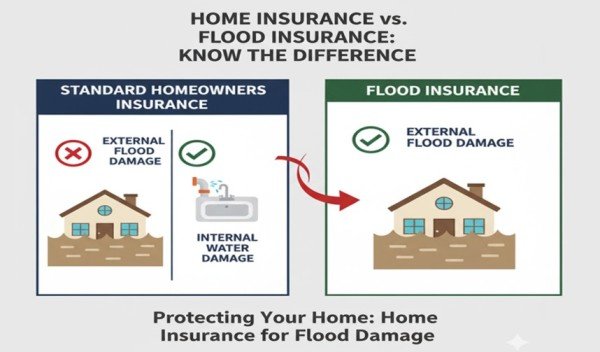
1. The Critical Difference: Homeowners Insurance vs. Flood Insurance
Let’s clear up the biggest misconception right away:
- Standard Homeowners Insurance (HO-3, HO-5, etc.): This typically covers water damage that originates from within your home (e.g., a burst pipe, an overflowing washing machine, a sudden roof leak from rain). It specifically EXCLUDES damage caused by water that originates from outside the home, such as a natural flood.
- Flood Insurance: This is a separate policy specifically designed to cover damage to your home and its contents caused by flooding. “Flooding” is typically defined as a general and temporary condition of partial or complete inundation of two or more acres of normally dry land or two or more properties (one of which is yours) from:
- Overflow of inland or tidal waters.
- Unusual and rapid accumulation or runoff of surface waters.
- Mudslides or mudflows.
- Collapse of land along a body of water as a result of erosion caused by waves or currents of water exceeding anticipated cyclical levels.
This distinction is vital for any homeowner, especially those living in flood-prone areas. Without dedicated Home Insurance for Flood Damage, you’re exposed.
A Tale of Two Water Damages: A Hypothetical Scenario
- Scenario A (Covered by Homeowners Insurance): Emily, a homeowner in Phoenix, AZ, comes home to find her kitchen flooded. A pipe under her sink burst, sending water across her floorboards and damaging her cabinets. Her standard homeowners policy would likely cover the repair costs and replacement of damaged property (minus her deductible).
- Scenario B (Requires Flood Insurance): Mark, who lives near a river in St. Louis, MO, experiences heavy, prolonged rainfall. The river overflows its banks, and floodwaters enter his home, damaging the same kitchen floorboards and cabinets. His standard homeowners policy would not cover this. He would need specific Home Insurance for Flood Damage to recover financially.
This demonstrates why dedicated water damage insurance for floods is not optional for those at risk.
2. Navigating the NFIP: Your Primary Source for Flood Insurance Coverage
In the United States, the primary source for Flood insurance coverage comes from the National Flood Insurance Program (NFIP), which is managed by the Federal Emergency Management Agency (FEMA). While administered by FEMA, policies are often sold and serviced by private insurance companies.
How NFIP Policies Work
NFIP policies provide coverage for both the structure of your home and its contents:
- Building Coverage: This covers the physical structure of your home, its foundation, plumbing, electrical systems, furnaces, water heaters, built-in appliances, permanently installed carpeting, and more. It can provide up to $250,000 in coverage.
- Contents Coverage: This covers your personal belongings, such as furniture, clothing, electronics, and other valuables. This is an optional addition and provides up to $100,000 in coverage.
It’s crucial to understand that these are separate coverage limits. If you need more coverage than the NFIP offers, you might need to explore private flood insurance options (discussed below).
Mandatory Purchase Requirements
If your home is in a high-risk flood area (officially designated as a Special Flood Hazard Area or SFHA) and you have a federally backed mortgage (which includes most mortgages), federal law requires you to have flood insurance. Even if it’s not mandated, the risk is still real. In fact, over 20% of NFIP claims come from properties outside of high-risk flood zones. This highlights why Homeowners insurance flood protection is a smart choice for everyone.
For detailed information on flood risks and policy specifics, visit the official FEMA National Flood Insurance Program (NFIP) website.
3. Beyond NFIP: Exploring Private Flood Insurance Options
While NFIP is the backbone of Home Insurance for Flood Damage, the private market for property insurance for floods has been growing. Private flood insurance policies are sold by private insurers and can offer several advantages:
- Higher Coverage Limits: Useful for high-value homes or those with expensive contents that exceed NFIP limits.
- Broader Coverage: Some private policies may offer additional coverages not found in NFIP policies, such as loss of use (living expenses if you can’t stay in your home due to flood damage) or basement contents coverage.
- Shorter Waiting Periods: NFIP policies typically have a 30-day waiting period, while some private policies may be shorter.
- Competitive Pricing: For some properties, especially those outside of high-risk zones, private flood insurance might be more affordable.
It’s always a good idea to compare quotes from both NFIP (through your local agent) and private insurers to find the best Home Insurance for Flood Damage for your specific needs.
4. Understanding Your Flood Damage Claims Process
If the worst happens and your home is affected by floodwaters, having natural disaster home insurance is only half the battle; knowing how to file a flood damage claim is the other half.
Steps to Filing a Home Insurance Claim for Flood Damage:
- Safety First: Ensure your family is safe. Do not enter your home if floodwaters are still present or if the structure appears unstable.
- Contact Your Insurer Immediately: As soon as it’s safe, notify your flood insurance provider. They will open a claim and assign an adjuster.
- Document the Damage:
- Take extensive photos and videos of all damaged areas before any cleanup.
- Do not throw away damaged items (especially high-value ones) until the adjuster has seen them, or you have documented them thoroughly.
- Create a detailed inventory of damaged contents, including descriptions, estimated age, and purchase price.
- Prevent Further Damage: Take reasonable steps to mitigate further loss (e.g., turn off utilities, remove standing water if safe, use fans). Keep receipts for any supplies purchased for this purpose.
- Meet with the Adjuster: Be present when the adjuster inspects your home. Point out all damaged areas.
- Review the Settlement: Carefully review the adjuster’s report and the proposed settlement. Ask questions if anything is unclear.
- Hypothetical Example (Louisiana Coast): After a hurricane brings significant storm surge, a homeowner in coastal Louisiana finds 2 feet of water in their ground floor. They immediately contact their NFIP provider. Following adjuster inspection and documentation of ruined furniture, flooring, and appliances, their Home Insurance for Flood Damage policy pays out for structural repairs and content replacement, minus their deductibles for both building and contents. This crucial Home insurance claim process enables them to begin rebuilding.
Learn more about how to prepare for and manage disaster recovery in our guide to Home Insurance Claim Process After Storm Damage.
5. Proactive Protection: Reducing Your Flood Risk and Premiums
Even with excellent Home Insurance for Flood Damage, prevention is key. Taking steps to reduce your flood risk can not only protect your home but potentially lower your insurance premiums.
- Know Your Flood Zone: Use FEMA’s Flood Map Service Center to understand your property’s specific flood risk.
- Elevate Utilities: Raise electrical panels, furnaces, water heaters, and washers/dryers above the base flood elevation.
- Install Backflow Valves: These prevent floodwater from backing up into your drains.
- Seal Cracks: Repair cracks in your foundation and seal openings to prevent seepage.
- Landscape for Drainage: Grade your yard so water drains away from your home.
- Elevate Your Home: In high-risk areas, consider elevating your home structure if possible.
- Secure Outdoor Items: Anchor fuel tanks and move valuable outdoor items indoors.
Many of these measures can make your home more resilient and might even qualify you for discounts on your Home Insurance for Flood Damage policy.
For in-depth resources on understanding your flood risk and taking mitigation actions, explore ready.gov floods section, a valuable resource from the US Department of Homeland Security.
FAQ: Home Insurance for Flood Damage
Q: Does my standard homeowners policy cover water damage from heavy rain? A: If the heavy rain causes a roof leak that damages your ceiling, yes. However, if the heavy rain causes water to accumulate on the ground and then enter your home (a flood), no. That requires specific Home Insurance for Flood Damage.
Q: Is there a waiting period for flood insurance to take effect? A: Yes, typically there is a 30-day waiting period for NFIP flood insurance policies to become effective after purchase. Private policies might have shorter waiting periods, but it’s important to confirm. Don’t wait until a storm is brewing!
Q: What is a flood zone determination? A: This is a document that officially indicates if a property is located in a Special Flood Hazard Area (SFHA) as designated by FEMA. Lenders use this to determine if Home Insurance for Flood Damage is federally mandated.
Q: Does flood insurance cover mold damage? A: Flood insurance typically covers mold damage that is a direct result of a covered flood, provided you take reasonable steps to mitigate the mold growth after the flood. Extensive mold from prolonged neglect may not be covered.
Q: Can I get flood insurance if I don’t live in a high-risk area? A: Absolutely! It’s highly recommended. Over 25% of all flood claims come from moderate-to-low risk areas. Flood insurance is often more affordable in these zones, offering vital property damage coverage for a lower premium.

Secure Your Sanctuary: Don’t Let Floodwaters Wash Away Your Future
The unpredictable nature of weather means that no home is truly immune to the risk of flooding. Understanding the crucial difference between standard homeowners policies and dedicated Home Insurance for Flood Damage is the first, most important step in protecting your greatest asset. Whether you’re in a high-risk zone or a seemingly safe area, flood insurance provides an essential financial safeguard.
Don’t wait until the water is rising to think about your coverage. Take the initiative now to assess your risk, explore your options, and ensure your home is resilient against whatever nature brings.
Assess your flood risk and understand your coverage options today. Protect your home and your peace of mind from unexpected flood damage!

Written by Imran Khan
Founder & Lead Content Specialist, Claimifio
Imran Khan brings over 8 years of experience in digital content creation and web development to Claimifio. As a Senior WordPress Developer at Zikra Infotech LLC, he has worked extensively with healthcare providers including emergency rooms, medical clinics, and specialty practices – giving him deep insight into the challenges patients and families face when navigating insurance systems.
His mission with Claimifio is simple: make insurance understandable for everyone. Every guide is researched thoroughly, written in plain English, and designed to help you take action with confidence.