
Myth Debunked: What “Full Coverage” Really Means in Car Insurance
You’ve heard the term: “I have full coverage.” It sounds like a golden ticket, a blanket of protection that covers absolutely everything that could happen to your vehicle or in an accident. But here’s the honest truth, often misunderstood by many drivers across the USA: “Full Coverage Car Insurance” isn’t a single policy, and it doesn’t cover every single thing.
Instead, “full coverage” is a commonly used colloquial term referring to a combination of several different types of auto insurance policies purchased together. These typically include Liability, Collision, and Comprehensive coverage, along with other optional additions. It’s designed to offer robust protection against a wide range of common perils, but it’s crucial to understand its actual components and limitations.
This ultimate guide will demystify Full Coverage Car Insurance in the USA, breaking down exactly what does full coverage mean, its essential components, what it doesn’t cover, and how to determine if this combination of policies is the right choice for your financial situation and driving needs.
1. What Does Full Coverage Car Insurance in the USA Actually Mean?
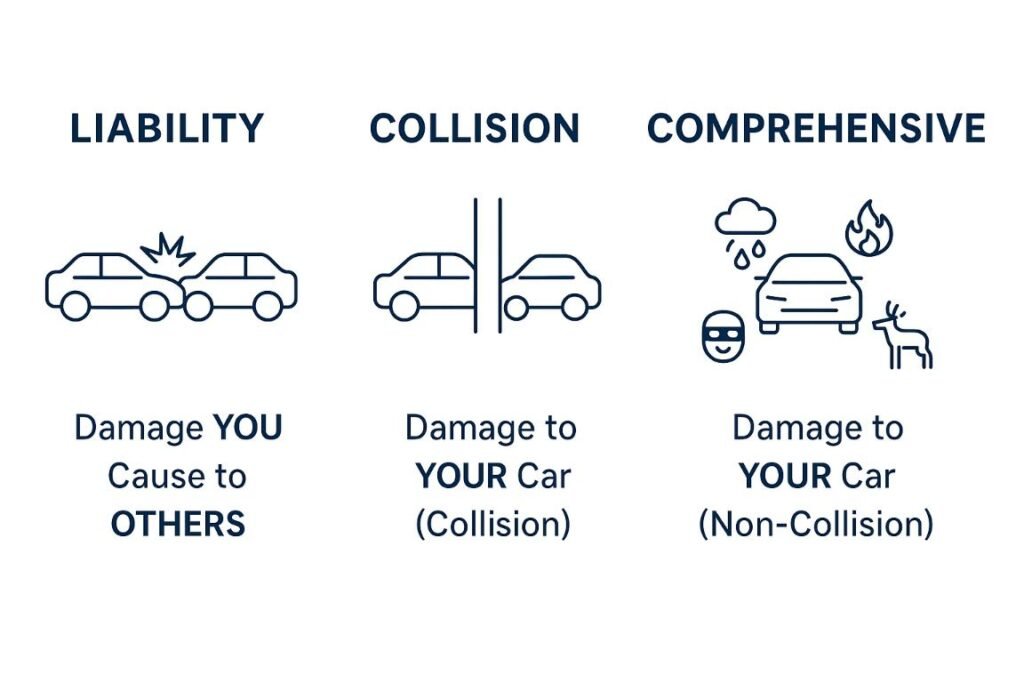
At its core, Full Coverage Car Insurance in the USA refers to a bundled approach to auto insurance that combines mandatory and optional coverages to provide broad financial protection. It typically includes:
- Liability Coverage (Bodily Injury & Property Damage): This is the foundation and is legally required in almost every U.S. state. It covers damages you cause to others in an at-fault accident.
- Collision Coverage: This pays for damages to your own vehicle if it collides with another car, an object (like a tree or pole), or rolls over, regardless of fault.
- Comprehensive Coverage: This protects your vehicle from damages not caused by a collision, such as theft, vandalism, fire, hail, falling objects, or hitting an animal.
These three components are the pillars of what most people refer to as “full coverage.” However, many drivers will also add other important coverages to truly round out their protection.
2. Breaking Down the Pillars: Core Components of Full Coverage
To truly understand what does full coverage mean, let’s explore its primary components in detail:
A. Liability Coverage (The Legal Must-Have)
This is the most fundamental part of your policy and is a legal requirement in almost every state. It protects your assets if you are found at fault for an accident.
- Bodily Injury Liability: Covers medical expenses, lost wages, and pain and suffering for others injured in an accident you cause.
- Property Damage Liability: Covers repairs or replacement of other people’s property (vehicles, fences, buildings) damaged in an accident you cause.
Most states mandate minimum liability limits (e.g., 25/50/25, meaning $25,000 for bodily injury per person, $50,000 for bodily injury per accident, and $25,000 for property damage). However, for robust protection, especially if you have significant assets, it’s wise to carry much higher limits.
B. Collision Coverage (Protecting Your Own Ride)
This coverage is designed to repair or replace your vehicle if it’s damaged in a collision.
- Scenarios: You hit another car, you hit a guardrail, you back into a pole, or your car rolls over.
- Deductible: Collision coverage almost always comes with a deductible (e.g., $500 or $1,000). This is the amount you pay out-of-pocket before your insurance kicks in. A higher deductible typically means a lower premium.
- When to Consider: Essential if you have a newer car, a loan, or a lease, as lenders almost always require it.
C. Comprehensive Coverage (Beyond Collisions)
Often paired with Collision, Comprehensive coverage protects your vehicle from non-collision damage.
- Scenarios: Theft, vandalism, fire, hail, flooding, falling objects (like a tree branch), or hitting an animal.
- Deductible: Like Collision, Comprehensive also usually has a deductible.
- When to Consider: Crucial if you live in areas prone to severe weather, have a valuable car, or worry about non-accident damage.
3. Beyond the Basics: Other Coverages Often Included in “Full Coverage”
While Liability, Collision, and Comprehensive form the core, many drivers expand their “full coverage” to include these valuable additions:
- Uninsured/Underinsured Motorist (UM/UIM) Coverage: Protects you if you’re hit by a driver who has no insurance (uninsured) or not enough insurance (underinsured) to cover your damages. This is critically important in many states where minimum liability limits are low.
- Medical Payments (MedPay) / Personal Injury Protection (PIP):
- MedPay: Covers medical expenses for you and your passengers, regardless of who is at fault for the accident.
- PIP: Similar to MedPay but often more comprehensive, covering medical expenses, lost wages, and essential services (like childcare) for you and your passengers, regardless of fault. PIP is mandatory in some “no-fault” states.
- Rental Car Reimbursement: Pays for a rental car while your vehicle is being repaired after a covered accident.
- Roadside Assistance: Covers services like towing, jump-starts, tire changes, or fuel delivery if your car breaks down.
Understanding your deductibles is key to managing costs. Learn more in our guide on Understanding Car Insurance Deductibles: How to Save Money & Manage Risk.
4. What “Full Coverage” Doesn’t Cover
It’s vital to know the limits of even comprehensive Full Coverage Car Insurance in the USA:
- Normal Wear and Tear: Routine maintenance, tire replacement due to age, or engine failure from old age are not covered.
- Intentional Damage: If you intentionally damage your own vehicle, insurance won’t pay.
- Commercial Use Without Proper Policy: Using your personal car for ridesharing (Uber/Lyft) or delivery services without specific rideshare or commercial insurance can invalidate your policy.
- Driving Under the Influence (DUI/DWI): While your liability might still pay for others’ damages, your own collision/comprehensive coverage could be denied, and you’ll face severe legal penalties.
- Items Stolen from Your Car: Your car insurance typically covers damage to the car itself (e.g., a broken window from theft). Stolen personal items (laptops, bags) are usually covered under your homeowner’s or renter’s insurance.
Hypothetical Scenario A: The Parking Lot Fender Bender
Sarah has “full coverage” on her 2020 Honda Civic. She accidentally backs into a pole in a parking lot, denting her rear bumper. No other vehicles or people are involved.
- Sarah’s Coverage: Her Collision Coverage will pay for the repairs to her Civic, minus her chosen deductible (e.g., $500).
- What’s NOT covered: If her new laptop was stolen from her car while parked, her auto insurance would not cover the laptop itself (but might cover the broken window).
5. Do I Need Full Coverage Car Insurance? Weighing the Pros and Cons
Deciding if Full Coverage Car Insurance in the USA is right for you involves balancing protection, risk tolerance, and cost.
When You Likely Need “Full Coverage”:
- Leased or Financed Vehicle: Lenders and lessors almost always require Collision and Comprehensive coverage to protect their investment.
- New or Valuable Vehicle: If your car is worth a significant amount, paying out-of-pocket for major repairs or total replacement would be financially devastating.
- Limited Savings: If you don’t have enough emergency savings to comfortably replace your vehicle after a major accident, “full coverage” is a wise investment.
- High-Risk Driving Areas: If you live in an area with high rates of theft, vandalism, severe weather, or frequent accidents.
- Peace of Mind: The emotional and financial stress of an accident can be immense. Comprehensive protection offers significant peace of mind.
When You Might Skip Some “Full Coverage” Components:
- Older, Low-Value Vehicles: If your car is worth less than $3,000-$5,000, the cost of Collision and Comprehensive premiums over time might outweigh what the insurance would pay out after a deductible. Consider dropping these coverages.
- Significant Savings: If you have substantial savings and can easily afford to replace or repair your vehicle entirely out-of-pocket.
- Only Need Legal Minimums: If your primary concern is simply meeting state legal requirements for liability.
Hypothetical Scenario B: The Older, Paid-Off Car
Mark drives a 2008 sedan that’s fully paid off and has a market value of about $4,000. He currently has “full coverage” with a $1,000 deductible for Collision and Comprehensive.
- Mark’s Dilemma: He realizes he’s paying about $400/year for Collision and Comprehensive. If he had an accident, the payout (after his deductible) would only be $3,000. Over 7-8 years, he could pay more in premiums than the car is worth.
- Mark’s Decision: He might decide to drop Collision and Comprehensive, saving on premiums, and instead rely on his emergency fund to cover potential damage to his own car, keeping only the legally required liability and perhaps UM/UIM. This is a common strategy for reducing the cost of full coverage insurance on older vehicles.
For authoritative, unbiased information on understanding auto insurance, state-specific requirements, and making informed decisions, consult the National Association of Insurance Commissioners (NAIC) consumer guide.
FAQ: Full Coverage Car Insurance in the USA
Q: Is “full coverage” always more expensive?
A: Generally, yes, because it combines multiple types of coverage (Liability, Collision, Comprehensive, and often more). However, the cost varies widely based on your vehicle, driving record, location, and chosen deductibles.
Q: Does “full coverage” apply to a rental car?
A: Typically, your personal “full coverage” policy extends to a rental car within the USA, covering liability and damage to the rental vehicle (up to your policy limits and subject to your deductibles). Always confirm with your insurer before renting.
Q: What is the average cost of full coverage car insurance in the USA?
A: There’s no single “average” as it depends on so many factors (state, age, vehicle, driving history, credit score in some states). However, it’s significantly more than minimum liability-only coverage, often ranging from $1,500 to $3,500+ annually.
Q: If I lease my car, do I have to get full coverage?
A: Yes, virtually all leasing companies and lenders require you to carry both Collision and Comprehensive coverage, along with specific liability limits, to protect their financial interest in the vehicle.
Q: Can I get full coverage with a bad driving record?
A: Yes, you can. However, you will likely pay significantly higher premiums for all components of “full coverage” compared to a driver with a clean record.

Drive Smart, Drive Protected: Your “Full Coverage” Advantage
Understanding Full Coverage Car Insurance in the USA is about more than just a catchy phrase; it’s about making informed decisions to protect your financial future. While it doesn’t cover every imaginable scenario, combining Liability, Collision, and Comprehensive—along with other strategic additions—provides a robust shield against the most common and costly risks on the road.
Don’t assume; investigate. Assess your vehicle’s value, your financial situation, and your risk tolerance. With this knowledge, you can confidently choose the right blend of coverages that truly secures your peace of mind behind the wheel.
Ready to get a clear picture of your auto insurance needs? Compare personalized quotes for “full coverage” options today and drive with confidence!

Written by Imran Khan
Founder & Lead Content Specialist, Claimifio
Imran Khan brings over 8 years of experience in digital content creation and web development to Claimifio. As a Senior WordPress Developer at Zikra Infotech LLC, he has worked extensively with healthcare providers including emergency rooms, medical clinics, and specialty practices – giving him deep insight into the challenges patients and families face when navigating insurance systems.
His mission with Claimifio is simple: make insurance understandable for everyone. Every guide is researched thoroughly, written in plain English, and designed to help you take action with confidence.